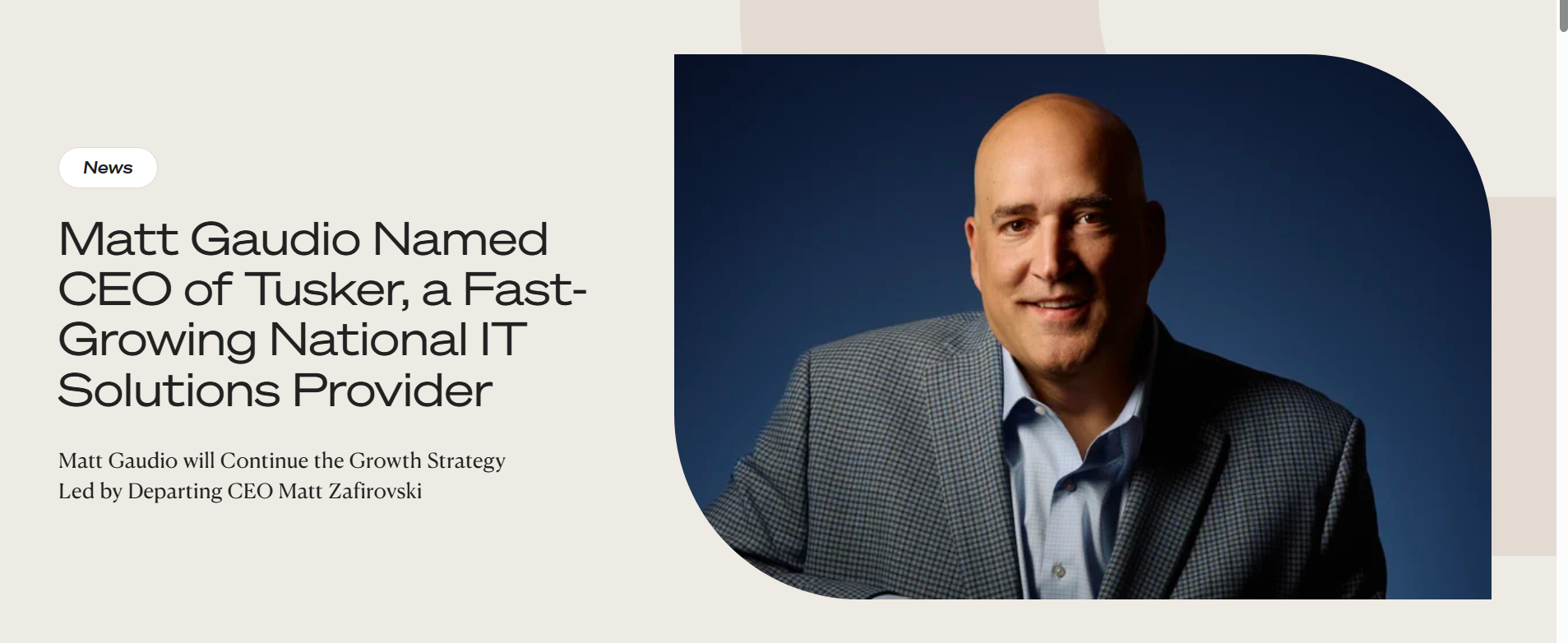
Matt Gaudio Appointed CEO of Tusker

The Zaf Group is very pleased to announce the appointment of Matt Gaudio as the new Chief Executive Officer of Tusker, effective October 5.

The appointment comes at an important point in Tusker’s development. The company is delivering its best year ever, with strong business momentum and continued progress across its One Tusker transformation.

In his previous role as Chief Solutions Officer, Matt was an integral part of that progress. He brings a deep understanding of Tusker’s people, customers, capabilities and strategy, together with extensive technology-industry experience, strong operating judgment. More importantly, beyond his wealth of knowledge, Matt G has shown a deep commitment to people and a leadership approach closely aligned with the values and expectations of both Tusker and The Zaf Group.

Matt Gaudio has earned the confidence of the organization and our Board,” said Mike Zafirovski, Founder of The Zaf Group and Executive Chairman of Tusker. “He understands the business, has contributed meaningfully to the transformation already underway and brings the leadership qualities we believe are important for Tusker’s next stage. We are excited to support him and the team as they build on the momentum in the business.”

The transition also marks the conclusion of Matt Zafirovski’s tenure as CEO of Tusker, with his final day on October 9 as he pursues a significant new leadership opportunity. The Zaf Group is deeply grateful for Matt’s leadership and the important contribution he made to Tusker’s growth and development over the past six years, and we wish him tremendous success in what comes next.

Tusker remains The Zaf Group’s most significant investment and an important part of our long-term strategy.

We will continue to support Tusker through the principles that guide our ownership approach: strong values, highest expectations for results and being the best, deep investment in people and leadership development, and a long-term commitment to building enduring businesses.

Read Tusker’s full announcement HERE

The New Private Equity Playbook Looks More Like Business Building

The private equity playbook is evolving. In many ways, the shift has already taken place.

Patient ownership, core business-building initiatives, disciplined execution, investment in people, leadership development, and stronger technology capabilities are no longer “nice to have.” They are becoming the norm for owners who want to build durable value.

This is especially true in an environment where growth is harder to manufacture and easier return drivers are less reliable. Recent industry research from McKinsey and Bain points to the same conclusion.

McKinsey’s 2026 private equity research argues that operational value creation must carry more of the returns burden, as traditional drivers such as low purchase prices, multiple expansion, and cheap leverage have become less dependable.

Bain’s 2026 Global Private Equity Report adds another important point: today’s deals demand faster EBITDA growth, sharper value creation, a clearer edge, stronger talent, AI investment, and execution beginning on Day 1.

That is a meaningful change. The best private equity firms are not just underwriting companies differently. They are owning them differently.

Comparison chart showing the shift from traditional private equity value creation to operational discipline and long-term business building.

Financial engineering is not enough

Private equity will always require financial discipline. Entry price matters. Capital structure matters. Cash flow matters. Exit strategy matters. But financial engineering alone is not enough.

A business ultimately creates value through its customers, people, products, services, processes, systems, and leadership. If those fundamentals do not improve, the investment thesis becomes much harder to realize. That is why operating discipline has become central to private equity value creation.

Good operating discipline means the company knows what it is trying to achieve and how it will get there. It means priorities are clear. Metrics are visible. Leaders are accountable. Teams understand the work. Problems are surfaced early. Progress is reviewed consistently.

It also means execution must be treated as a capability. Not a slogan. Not a meeting topic. A capability.

Companies that execute well build momentum. They make better decisions faster. They learn faster. They turn strategy into action. Over time, that discipline compounds. This is where value creation becomes much more than a spreadsheet. It becomes the daily work of building a stronger business.

Circular diagram showing TZG’s active ownership approach: assess, align, execute, measure, and reassess.

A one-time plan is no longer sufficient

Every acquisition begins with a plan. But no plan survives unchanged.

Customer expectations shift. Technology changes workflows. Labor markets tighten or loosen. Competitors move. Pricing pressure appears. New opportunities emerge. Economic conditions change the speed and shape of growth. That is why the old idea of creating a plan at acquisition and following it through to the exit is no longer sufficient.

Even in situations where the intended hold period is shorter, the work has to be dynamic. Quicker flipping still depends on whether the business can respond quickly to new information, execute high-impact priorities, and remain relevant in a changing market.

McKinsey describes one part of this shift as “re-underwriting” value during the hold period. Leading firms revisit the original investment thesis, reassess the company’s full potential, and update the value creation agenda as conditions change.

That mindset is important. A company should not be managed only against what was believed at closing. It should be managed against what is possible now. This requires an operating cadence: a rhythm of strategy reviews, performance discussions, talent conversations, growth planning, and execution follow-up.

Cadence matters because it keeps the work alive. It helps teams stay aligned. It keeps priorities from drifting. It creates space to ask whether the plan still fits the reality of the business. In a market shaped by faster technology cycles and more complex economic conditions, that kind of regular reassessment is not optional. It is part of responsible ownership.

People and leadership are value creation levers

The most important lever in value creation is often the one that looks least financial at first. People.

Strong leaders can change the trajectory of a company. They bring clarity, urgency, judgment, energy, and accountability. They build teams. They set standards. They create trust. They know when to push, when to listen, and when to change direction.

Weak leadership does the opposite. It slows decisions. It creates confusion. It allows priorities to multiply. It makes execution inconsistent. It can turn even a strong strategy into an average result.

This is why people and leadership are returning to the center of the private equity value creation conversation.

McKinsey notes that 94 percent of sponsors say portfolio company leadership drives value creation, while only 8 percent report systematically investing in that leadership capacity.

That gap should get attention. If leadership drives value creation, then leadership development needs to be treated as part of the value creation plan. This includes hiring the right people, developing internal talent, strengthening leadership teams, creating clear accountability, and building cultures where people can perform at a high level.

It also means investing in leaders with integrity. In a demanding ownership environment, values matter. Leaders need to make difficult decisions. They need to build trust with employees, customers, partners, and investors. They need to communicate clearly and act consistently. They need to pursue performance without losing sight of responsibility.

For long-term owners, that combination is essential. Performance matters. Character and Integrity matter too.

Six-pillar graphic showing leadership, people, culture, capabilities, cadence, and execution as foundations for enduring business building.

Why this feels familiar to TZG

We see this shift as consistent with how we have always thought about building enduring businesses. We are long-term owners and partners. Our goal is not simply to acquire companies. It is to help strong businesses become stronger.

That means respecting the heritage of a company while investing in what it needs for the next stage of growth.

It means focusing on leadership, people, culture, capabilities, cadence, and execution. It means supporting portfolio companies with a practical operating model, not just a financial thesis. And it means staying grounded in Our Values.

Our ICARE2 values: Integrity, Collaboration, Accountability, Responsibility, Excellence, and Effectiveness; are central to how we work. They guide how we lead, how we partner, how we support portfolio companies, and how we think about long-term value creation. In that sense, the new private equity playbook looks very familiar.

  • It looks like patient ownership.
  • It looks like operational excellence.
  • It looks like investing in people.
  • It looks like disciplined execution.
  • It looks like leadership with integrity.

And most of all, it looks like the steady, consistent work of building enduring businesses.

We welcome thoughtful conversations and exchange of ideas with founders, operators, and investors.
Mike Zafirovski’s 2026 Scenic Shore Bike Tour Fundraiser

Mike Zafirovski is riding 150 miles over 2 days in Wisconsin with the Riders of the Storm Team as part of the 2026 Scenic Shore Bike Tour, raising funds for Blood Cancer United, formerly The Leukemia & Lymphoma Society.

Mike is riding to honor the memory of five people close to him, his family, and the broader TZG community who lost their lives to cancer.

Blood Cancer United helps drive meaningful progress in cancer research, patient support, and the development of new therapies. While its mission begins with blood cancers, the breakthroughs it supports often extend far beyond leukemia and lymphoma, helping advance the broader fight against many forms of cancer.

The Riders of the Storm Team has set a goal of raising $500K this year, and Mike has set a personal goal of raising $100K toward that effort.

Donations are made directly through Blood Cancer United’s official Scenic Shore fundraising platform.

Thank you for considering a contribution.

Blood Cancer United is a 501(c)(3) organization. Monetary donations are tax-deductible to the fullest extent allowed by law. Please consult your financial advisor with any tax-related questions. Tax Identification Number: 13-5644916.

Storr Office Environments Names Trevor Croghan Chief Executive Officer

Veteran Steelcase dealer executive to lead Storr’s next chapter across North Carolina

Raleigh, NC & Chicago, IL — [June 3, 2026] Storr Office Environments today announced that Trevor Croghan will join the company as its next Chief Executive Officer.

Trevor begins on-site August 3, 2026, and will work with Storr’s leadership team in the interim on planning, customer engagement, and transition priorities. He succeeds Tom Vande Guchte, who alongside Bob Schanz spent more than three decades building Storr into one of the Southeast’s most trusted workplace solutions companies before positioning it for continued growth through its acquisition by The Zaf Group (TZG) in 2025.

Trevor joins Storr from One Workplace, one of the nation’s largest Steelcase dealer organizations, where he spent 19 years in progressively senior roles. A San Francisco Bay Area native, he founded One Workplace’s Learning Environments division, led healthcare and government sales, directed enterprise growth strategy, oversaw Washington state operations in Seattle and Spokane, and sponsored enterprise initiatives including ESG, AI, and emerging leader development.

Founded in 1914, Storr has spent more than a century building trust with customers across North Carolina and the Southeast. Today, the company helps organizations create, furnish, maintain, relocate, and adapt their workplaces through a single integrated partner—with capabilities spanning strategy and design, furniture procurement and installation, moving and reconfiguration, facility maintenance, records management, PreOwned solutions, cleaning, refurbishment, and warehousing.

Following its acquisition from TZG, Storr is focused on expanding service capabilities, investing in technology, attracting top talent—building on more than a century of customer relationships while competing in an increasingly dynamic workplace market.

“Trevor brings the combination we hoped to find: deep industry experience, a track record of performance, real sales acumen, and a values-based leadership style that fits both Storr’s culture and TZG’s long-term ownership philosophy” said Mike Zafirovski, Founder of The Zaf Group and Chairman of Storr. “He is also a person of deep Faith, which matters to us. He understands the Steelcase dealer ecosystem deeply, has built diversified capabilities around customers, developed leaders, and expanded into new markets — that is exactly what Storr needs for its next chapter. We are deeply grateful to Tom and Bob for what they built here. Over 35 years, they created one of the most respected workplace solutions companies in the Southeast — not just in results and capabilities, but in culture, values, and community impact. Our family is proud to be only the fourth owner in Storr’s 112-year history. Our intention is to own Storr in perpetuity and grow it in a way that benefits its team members, customers, vendor partners, and the communities it serves.”

Bob and I have cared deeply about finding the right leader for Storr. said Tom Vande Guchte, outgoing CEO. “This company has always been about more than furniture. It has been about people, trust, service, and doing our best for our customers and our community. We wanted a leader who would honor that legacy while bringing the experience, Faith, and energy to help Storr grow. We believe he is that person and we look forward to our team and customers getting to know him.”

Trevor Croghan said, “I am honored to join Storr and grateful for the trust placed in me by Tom, Bob, Mike, and the broader TZG team. Throughout this process, I have developed a deep respect for Storr’s people, culture, and legacy, along with its longstanding commitment to customers, community impact, and faith-driven values. This is a remarkable company with a strong foundation and tremendous opportunity ahead. I am energized by the future of our industry, the strength of the North Carolina markets we serve, and the opportunity to help lead Storr’s next chapter of growth. My first priority will be to listen, learn, and build relationships with the team members, customers, vendor partners, and community leaders who have shaped Storr’s success. From there, I look forward to working alongside the Storr team to grow the business, develop our people, expand our capabilities, and continue delivering exceptional value to our customers.”

Storr will continue to operate with the same commitment to customers, team members, vendor partners, and communities. Trevor will spend the coming months meeting with key customers, partners, and community stakeholders before beginning full-time on-site in August.

About Storr Office Environments

Founded in 1914 and headquartered in Raleigh, North Carolina, Storr Office Environments is a trusted leader in workplace solutions provider serving North Carolina and the Southeast. As a premier Steelcase dealer, Storr delivers high-performance office furniture, architectural products, and a full range of services tailored to customer needs, including workplace strategy and design, office relocation and reconfiguration, furniture refurbishment, facility maintenance, records management, PreOwned furniture solutions, cleaning, delivery and installation, warehousing, and light construction. Storr’s purpose is simple and profound: “To positively impact the lives of our team members, customers, and communities.” Its values: “Do what is right. Do your best. Treat others as you would like to be treated.”

Learn more at www.storr.com.

Media Contact:
Jimmy Beech
Storr Office Environments
[email protected] | M: 919-538-2301

About The Zaf Group

The Zaf Group is a family office of former GE, Motorola, Nortel, and Blackstone executive Mike Zafirovski and his wife Robin, dedicated to partnering with and growing family and founder-led businesses with a long-term mindset. TZG’s mission is to build great companies guided by the highest of values, expectations for strong results, a deep commitment to developing people, and in meritocracy. TZG’s portfolio includes Storr Office Environments and Tusker, a national IT solutions provider.

Learn more at: www.thezafgroup.com.

Media Contact:
Fidan Nikolovski
The Zaf Group
[email protected] | M: +389-75-445-759

Download the PDF Version

Why Operational Excellence Is Defining the Next Era of Private Markets

Introduction — A Structural Shift in Private Markets

Private equity is entering a new phase.

Not because of short-term cycles, interest rates, or geopolitical developments—but because of a deeper structural shift in how value is created.

For much of the past decade, strong returns were supported by favorable conditions: multiple expansion, low-cost leverage, and efficient exit strategies.

That environment has changed.

Recent industry research, including insights from a recent PE report from Bain & Company, points to a clear trend: returns are increasingly driven by operational execution rather than financial engineering.

Longer Holding Periods, Fewer Easy Wins

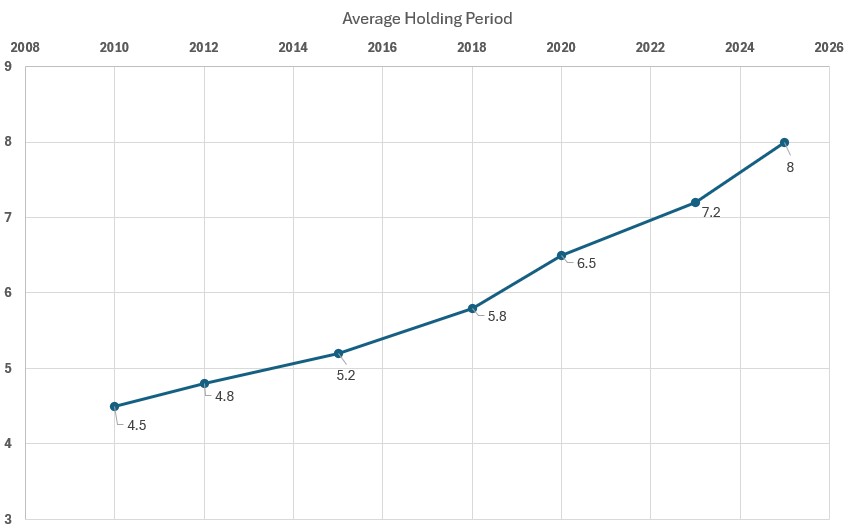
One of the most notable developments is the extension of holding periods. What was once a typical 3–5 year investment horizon is now often significantly longer, giving rise to the idea that 12 is the new 5, meaning today’s deals demand faster EBITDA growth. Estimated annual EBITDA growth needed for 2.5x return over 5 years has risen in a world where low prices, cheap debt, and easy multiple expansion are gone for the foreseeable future. This shift reflects:

  • Slower exit environments
  • Increased cost of capital
  • Greater selectivity from buyers

As a result, value creation must now occur within the business, not around it.

Average Holding Period for PE firms

From Financial Engineering to Execution Discipline

Historically, private equity returns were driven by three primary levers:

  • Revenue growth
  • Margin expansion
  • Multiple expansion

Today, the balance has shifted. Multiple expansion is less predictable. Leverage is more constrained.That leaves one consistent and controllable driver:

Operational Excellence.

This includes:

  • Pricing discipline
  • Cost structure optimization
  • Sales effectiveness
  • Organizational alignment
  • Execution cadence

In this environment, success depends less on timing the market—and more on how effectively a business is run.

What Operational Excellence Actually Means

Operational excellence is often discussed but rarely defined clearly. We view it as a combination of three elements:

1. Clarity
Clear strategic priorities and decision-making frameworks.

2. Discipline
Consistent follow-through, accountability, and measurement.

3. Rhythm
A structured cadence that ensures focus throughout the year.

These elements are embedded in our T1–T4 Operating System, which aligns leadership teams around:

  • People and organization (Q1)
  • Strategy (Q2)
  • Growth and development (Q3)
  • Budget and alignment (Q4)

This cadence creates visibility, reinforces accountability, and ensures that execution remains consistent—not reactive.

A More Competitive Era Requires Better Execution

The private equity landscape is becoming increasingly competitive. More capital is chasing fewer high-quality opportunities. At the same time, exit timelines are extending, and value creation windows are widening.

In this environment:

  • Strong assets alone are not enough
  • Strategy alone is not enough
  • Capital alone is not enough

Execution becomes the differentiator.

Firms that can systematically improve performance at the operational level will outperform those that rely on market conditions.

Conclusion — The New Source of Alpha

Private markets have always evolved. What is different today is the source of advantage. In a world where external conditions are less predictable, the focus shifts inward—to what can be controlled.

Operational excellence is no longer optional. It is defining the next era of private equity.

At TZG, this has long been a core principle:
Building better businesses through disciplined execution, structured cadence, and a long-term mindset.

See the full original research document here

We welcome thoughtful conversations and exchange of ideas with founders, operators, and investors.

What Investor Behavior Tells Us About Private Markets

Private markets have undergone a quiet but profound transformation over the past decade. Once viewed primarily as the domain of large institutions, they are increasingly becoming a central component of sophisticated individual portfolios. Recent investor research by Goldman Sachs offers valuable insight into how perceptions, allocations, and priorities are evolving, and what these shifts signal for long-term investors and business builders.

While market commentary often focuses on short-term sentiment, investor allocation behavior offers a more durable signal. The 2025 survey reveals not only continued interest in alternative investments but also a maturing perspective on risk, liquidity, and long-term value creation.

For TZG, these findings echo themes we observe across private market transactions, investor dialogue, and capital formation dynamics.

Alternatives Adoption Reflects Portfolio Maturity

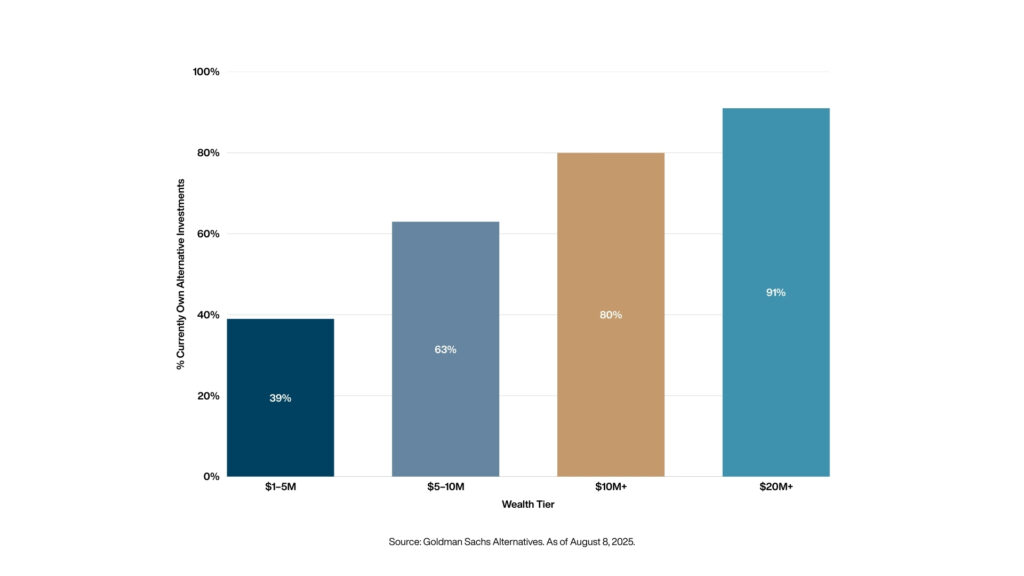
One of the most consistent patterns emerging from investor data is the relationship between wealth and alternatives adoption. As portfolios grow, allocations to private equity, private credit, and private real estate tend to increase meaningfully.

% Share of people who have alternatives in their investment portfolio

Investors in the lower wealth tiers often prioritize liquidity and capital preservation. However, beyond certain portfolio thresholds, alternatives adoption accelerates sharply. This inflection point suggests that exposure to private markets increasingly becomes not an opportunistic choice, but a structural allocation decision.

For experienced investors, alternatives serve several strategic purposes:

  • Traditional equity/bond portfolios face structural challenges
  • Return dispersion is widening
  • Diversification benefits of private markets remain compelling
  • Reduced reliance on public market cycles

Risk Perception vs. Investment Reality

Despite growing adoption, a significant number of investors continue to label alternative investments as “high risk.” This perception often stems from concerns about illiquidity, complexity, or unfamiliarity rather than underlying asset fundamentals.

Interestingly, research shows a notable divergence between perception and experience. Investors already allocating to alternatives frequently rate them as less risky than non-users. Familiarity, transparency, and time horizon alignment appear to reshape risk interpretation.

Illiquidity, in particular, remains widely misunderstood. For investors with long-term capital and disciplined portfolio construction, reduced liquidity is not inherently a disadvantage. In many cases, it serves as a structural feature that supports long-duration value creation strategies.

Growth Increasingly Resides in Private Markets

Another structural factor driving investor behavior is the changing composition of the global business landscape. The number of publicly listed companies has declined significantly over recent decades, while private equity-backed enterprises have multiplied.

Many of today’s most dynamic companies choose to remain private longer. They seek operational flexibility, long-term capital alignment, and reduced short-term market pressures. As a result, a growing share of innovation, transformation, and value creation occurs outside public exchanges.

For investors focused on capturing these growth dynamics, private markets are evolving from “alternative” to “essential.”

The Generational Reframing of Portfolio Strategy

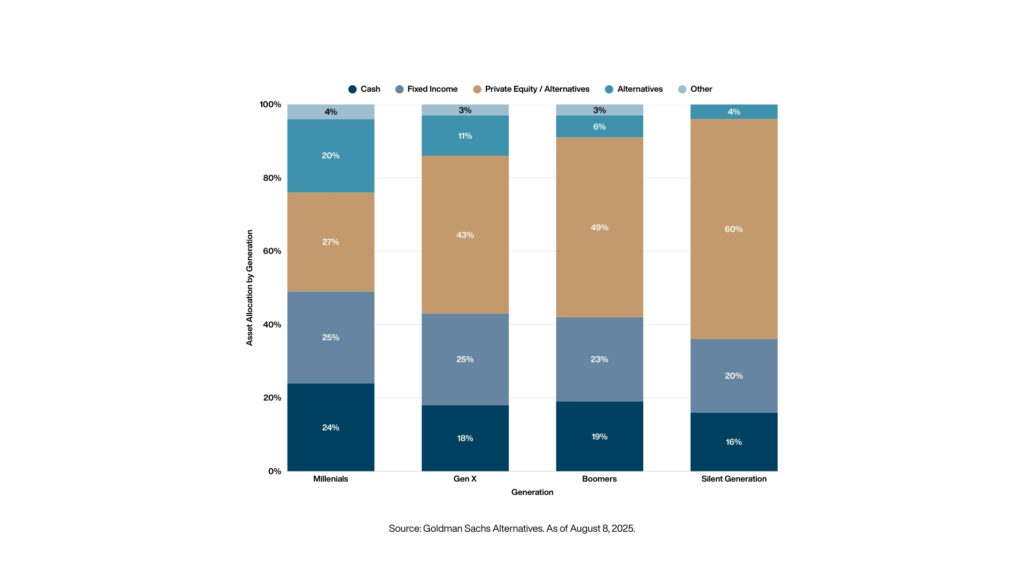
Generational differences further reinforce this trajectory. Younger investors demonstrate higher familiarity with alternatives and greater openness to private market exposure. Their motivations often extend beyond diversification toward:

  • Access to innovation
  • Unique investment opportunities
  • Long-term capital growth
  • Differentiated sources of return
Asset Allocation by Generation

This shift reflects not only changing product accessibility but also a broader reframing of portfolio construction philosophy.

Education and Clarity Remain Critical

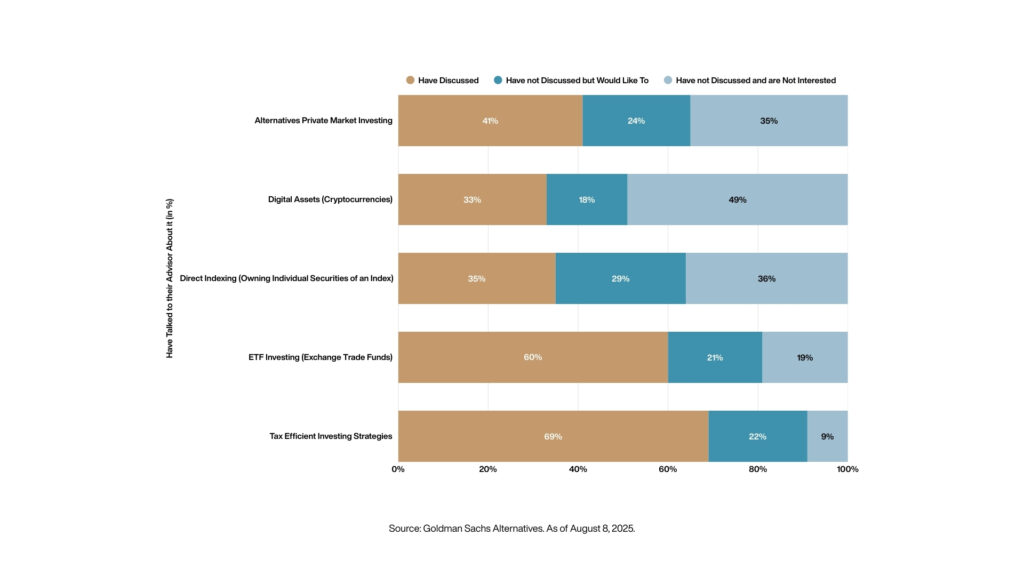
While adoption trends are clear, research also highlights a persistent education gap. Alternatives are discussed less frequently between advisors and clients compared to traditional products such as ETFs or tax strategies.

Level of Education among Investors about Different Strategies

As private markets continue to expand their role, investor outcomes will increasingly depend on:

  • Clarity of objectives
  • Understanding of liquidity profiles
  • Alignment with time horizons
  • Selection of experienced partners
  • Thoughtful portfolio integration

The TZG Perspective

Investor behavior offers more than a snapshot of allocation preferences. It reflects a deeper recognition that markets, businesses, and value creation pathways are evolving.

For long-term investors, the conversation is shifting from “Should alternatives be included?” to “How should alternatives be integrated intelligently?”

For operators and business builders, this shift reinforces the enduring relevance of private ownership structures that prioritize patience, discipline, and long-term strategy execution.

We have long believed that durable value is built through disciplined execution, strong partnerships, and patient capital. Private markets naturally align with these principles. They provide an environment where transformation, operational excellence, and long-term thinking can compound over time.

As investor behavior continues to evolve, it becomes increasingly evident that private markets are not simply expanding, they are redefining the architecture of investing. They continue to offer compelling opportunities for disciplined investors focused on operational effectiveness, resilience, and long-term value creation.

See the full original research document here

We welcome thoughtful conversations and exchange of ideas with founders, operators, and investors.

The Formula for Enduring Success in Family-Owned Businesses

What makes family-owned companies not just survive – but outperform?

Family-owned businesses generate more than 70 % of global GDP and employ 60 % of the world’s workforce. Their impact – and their example – are extraordinary.

A recent McKinsey & Company Study Report found that family businesses combine resilience with superior long-term performance.

Across 1,800 companies analyzed, family-controlled firms achieved higher economic profit and shareholder returns than non-family peers—often by thinking in generations, not quarters. The report finds 4 critical mindsets and 5 strategic actions that are specific to high performing family-owned businesses.

1. Purpose Beyond Profits

McKinsey found that 93% of top-performing family businesses define a clear purpose beyond financial returns—and more than half actively measure their social and environmental impact.
These organizations view purpose as an operational compass, shaping decisions from hiring to community engagement.

TZG Perspective:
We believe that values create value. Our TZG Way centers on integrity, meritocracy, and devotion to excellence—principles that guide not only investment decisions but also how we support our portfolio leaders.
When purpose is embedded in culture, performance follows.

2. A Long-Term View and Reinvestment Mindset

The outperformers McKinsey studied share a “decades mindset,” favoring reinvestment over dividends. Between 2017 and 2022, family-owned firms delivered dividend yields 12% lower than peers yet achieved higher economic profit and proved far more resilient in crises.

TZG Perspective:
Patient capital is an advantage. We reinvest earnings to fuel talent growth, innovation, and efficiency rather than optimize for short-term payouts.
Through multi-year planning and close operational partnerships, we help our companies scale without sacrificing their DNA.

3. Financial Caution and Resilience

Family businesses are known for conservative balance sheets—and McKinsey’s data confirms it.
Their net debt-to-equity ratios are 6–10 points lower than peers’, providing the buffer needed to weather recessions and rebound faster. The lesson: prudence enables independence.

TZG Perspective:
As a family office, we share that discipline. Every acquisition is structured to strengthen—not strain—the balance sheet.
We prioritize flexibility and optionality in financing, ensuring our partners can invest when opportunity arises and stand resilient when markets tighten.

4. Efficiency and Decision Speed

Unlike clunky corporations slowed by layers of bureaucracy, high-performing family enterprises excel at fast, values-aligned decision-making making them more efficient at both investing and operations compared to their peers.
McKinsey found that they balance agility with deliberation – acting quickly when aligned, patiently when perspectives diverge.

TZG Perspective:
Our partnerships reflect the same model.
We invest in leadership development and culture building, empowering management teams with autonomy while maintaining clarity of purpose and accountability.

5. Strategic Actions That Differentiate Winners

McKinsey highlights five strategic actions that, combined with these mindsets, deliver outsized results:

  1. Diversification
  2. Dynamic resource allocation
  3. Capital and operational efficiency
  4. Relentless focus on talent
  5. Strong governance

At The Zaf Group (TZG), our mission to build impactful, values-based businesses has led us to partner with exceptional family- and founder-led companies such as ACP CreativIT and Storr.
The McKinsey findings validate what has guided our “TZG Way” investment philosophy from day one—and reflect how we build enduring value:

  • Drive smart growth through a combination of organic expansion and strategic M&A that strengthen the core.
  • Pursue operational excellence, focusing relentlessly on high-impact growth levers.
  • Invest in people and governance, ensuring both continuity and accountability.

These are principles we live by at TZG – helping family businesses grow stronger, smarter, and more sustainable. Purpose, patience, prudence, and people are the cornerstones of lasting success.


Learn More

Explore the full McKinsey report including a link to the original Study HERE.

Visit our Portfolio to see the family-owned companies TZG partners with.

Follow The Zaf Group on LinkedIn for more insights on leadership, growth, and long-term value creation.

Press Release — The Zaf Group Partners with Storr

The Zaf Group Partners with Storr, Strengthening a Century-Old Legacy in North Carolina

Chicago, IL & Raleigh, NC — October 1, 2025 —

The Zaf Group (TZG), the family office of former GE, Motorola, Nortel, and Blackstone executive Mike Zafirovski and his wife Robin, is pleased to announce its strategic partnership with Storr Office Environments, one of the Southeast’s premier workplace solutions providers and among the largest Steelcase dealers in the United States.

Founded in 1914 and headquartered in Raleigh, NC, Storr has built more than a century of trust with clients through its long-standing partnership with Steelcase and its customer-first approach. In addition to offering high-performance office furniture and architectural products, Storr has steadily expanded its portfolio of workplace services — from strategy and design to move management, refurbishment, and ongoing facility support — while maintaining a strong culture of community engagement and charitable giving, upholding its simple guiding principle: “Do what’s right, do your best, and treat others as you would like to be treated”. These offerings are uniquely tailored to reduce complexity, extend the value of client investments, and ensure long-term satisfaction.

This partnership reflects TZG’s commitment to family- and founder-led businesses with enduring values and a long-term vision. Together, TZG and Storr will focus on continuity, stability, and investment in people — strengthening the foundation that has made Storr a trusted partner for generations, while equipping the company for its next chapter of growth.

Mike Zafirovski

“Storr is a remarkable company — not just for its legacy of charity in the community, but for its outstanding team, deep customer relationships, and unwavering values,” said Mike Zafirovski, Founder and Chairman of The Zaf Group.

“We are honored to partner with Tom, the Storr leadership, and the broader Storr team. Our goal is to support and enhance what already works, elevating the organization’s capabilities while preserving its strong cultural foundation.”

“Partnering with TZG allows us to preserve the authentic Storr experience while unlocking new opportunities for growth,” said Tom Vande Guchte, CEO of Storr.

“Mike and his team understand the dynamics of family-led businesses, and we’re excited to see how this collaboration will strengthen our ability to serve clients, invest in our people, continue our tradition of giving back to the community, and stay true to our heritage.”

Tom Vande Guchte CEO of Storr

For TZG, this marks another step in its values-based strategy to grow exceptional companies. Following its successful partnership with ACP CreativIT — a rapidly expanding U.S. IT solutions provider — and the transition of ABCO Systems earlier in 2025, TZG remains committed to building long-term value by investing in great teams, strong cultures, and sustainable growth strategies.

Together, TZG and Storr will continue to deliver the deep-rooted client partnerships, local presence, community commitment, and exceptional service that have defined Storr’s history — now reinforced by TZG’s resources, network, and long-term perspective.

About The Zaf Group (TZG)

The Zaf Group is a family office established by Mike Zafirovski and his wife Robin, dedicated to partnering and growing family- and founder-led businesses with a long-term mindset. Its portfolio includes ACP CreativIT (IT solutions), the recently transitioned ABCO Systems (systems integrator), and now Storr (office & workplace solutions). TZG’s mission is to build great companies guided by values-based leadership, operational excellence, and a deep commitment to people development.
Learn more at www.thezafgroup.com

About Storr

Founded in 1914, Storr Office Environments is a trusted leader in workplace solutions across North Carolina and the Southeast. As a premier Steelcase dealer, Storr provides high-performance office furniture, architectural products, and a complete range of services tailored to customer needs — including Workplace Strategy and Design, Office Relocation and Reconfiguration, Furniture Repair and Refurbishment, Facility Maintenance and Day-Two Support, Records Management, PreOwned Furniture Solutions, Cleaning and Sanitization Services, Delivery and Installation, and Secure Storage.

Storr’s century-long success is rooted in its customer-first approach and strong charitable commitments: every solution is designed to simplify complexity, maximize value, and strengthen both client partnerships and the broader community.
Learn more at www.storr.com

What Makes Founder-Led Businesses Unique

Family- and founder-led companies have always been the backbone of the U.S. economy. They account for over 60% of GDP and employ more than half of the nation’s workforce. Despite their critical role, these businesses are often overlooked or misunderstood by investors seeking short-term returns. But family-owned businesses possess some unique characteristics that are especially relevant in today’s fast-moving business landscape. Here’s why we pay close attention when a founder or family is still at the helm.

A Long-Term Mindset
Founder-led companies are usually built for the long haul. Founders think in building a legacy, not just making it to the next quarter, and are more likely to invest in innovation, reputation, and relationships over time even if it means short-term sacrifices. In a world of economic swings and constant disruption, it’s the companies with long-term orientation that tend to remain focused and adaptable

Deep Customer Relationships
Many founders started by winning one customer at a time — personally. That early commitment to solving real problems, being available, and listening deeply often carries through as the company grows. This results in family-owned companies having very strong customer loyalty, and usually a brand built on trust, not mere marketing spend.

Cultural Clarity and Purpose
Founder-led companies often have a culture shaped by the founder’s values. That kind of clarity is hard to replicate in professionally managed organizations and larger corporations where leadership turns over frequently. Family owned businesses usually have stronger team alignment and faster decision-making. They tend to hire and retain people who understand the company’s purpose and direction.

Operational Discipline with an Owner’s Mentality
Many founders grow their businesses with limited resources. That experience builds into their operational habits: running lean, solving problems directly, avoiding waste, and maintaining a close, hands-on approach to operations. This “owner’s mindset” translates into companies that are more resilient, especially in uncertain markets.

As a family business ourselves, we believe founder-led companies carry something deeply valuable: long-term vision, strong culture, and a deep sense of ownership.

When a founder is still at the helm, or their values still shape the organization, you tend to find a clarity of purpose that’s hard to replicate. These businesses usually know who they are. They’ve weathered ups and downs not by chasing trends, but by staying true to their customers and teams. They’re often leaders in niche industries with loyal clients, deep operational knowledge, and strong reputations.

But founder-led doesn’t mean perfect. Succession planning can be unclear. Growth may have outpaced systems. Founders might struggle to delegate or scale sustainably. That’s where thoughtful partnership can make a difference, one that respects the founder’s legacy while unlocking new potential.

TZG’s own approach is to combine values-driven leadership with professionalization and strategic support creates powerful outcomes for our portfolio of family owned businesses.

For long term investors like us, focused on strategic stewardship, not quick flips, these kinds of companies offer more than financial upside. They offer alignment with our own values, and the chance to help something already great grow even stronger.

If you yourself are, or know a founder or a family business owner thinking about the future, feel free to contact us. We’re always interested in speaking with well run family businesses that are profitable, resilient, and ready for the next chapter, especially in B2B services, niche manufacturing, or healthcare, where operational excellence and reputation matter deeply.

ABCO Systems to Begin New Chapter with Element Logic Following Successful Run with The Zaf Group

The Zaf Group is pleased to announce the sale of ABCO Systems, a leading provider of material handling solutions, to Element Logic, a strategic acquirer specializing in warehouse optimization technologies. This transaction marks an exciting milestone for ABCO and positions the business, its employees, and its customers for continued growth, innovation, and long-term success.

The sale reflects The Zaf Group’s commitment to building enduring companies, and where necessary, identifying strong partners to lead them through their next phase of evolution.

“It has been a true privilege to partner with ABCO over the past five years.” said Mike Zafirovski, Chairman and CEO of The Zaf Group. “The people and the culture are what make this company so special, and we’ve been constantly inspired by the team’s passion, resilience, and commitment to excellence. As stewards of the business, our goal was always to support its long-term growth and to invest in its people. We’re incredibly proud of what we have accomplished together and have full confidence that the Element Logic team will continue to build on this foundation and take the company to even greater heights.”

During its partnership with The Zaf Group, ABCO experienced substantial growth and transformation, including:

• Doubled the size of company while maintaining a strong company culture and employee engagement, earning “Best Places to Work in NJ” recognition for three consecutive years


• Achieved significant growth through disciplined execution, market-driven solutions, and strategic geographic expansion via multiple new office locations


• Relocated its headquarters to a new, modern facility featuring a state-of-the-art showroom

These achievements are a testament to the strength of ABCO’s leadership team, the dedication of its employees combined with the long-term investment philosophy and value creating capabilities of The Zaf Group. The leadership team is immensely proud of the growth they’ve achieved together and is energized by the opportunities that lie ahead with Element.

“We are proud to have partnered with The Zaf Group over the past five years,” said Seth Weisberg, CEO of ABCO Systems. “Through smart growth, a relentless focus on customers, and a deep investment in people and infrastructure, the team has built an exceptional platform. We are confident that our new partnership with Element Logic will build on this momentum and allow us to continue to lead in the material handling solutions industry.”

“This is more than an acquisition – it is a perfect fit. ABCO’s strong commercial presence, complementary solutions, and customer-first approach are fully aligned with our values. By combining our strengths, we are empowering customers to optimize performance through holistic warehouse automation solutions that scale with their needs.” Krish Nathan, CEO – Element Logic Americas.

The Zaf Group would also like to thank Stillwater Capital for their partnership and guidance throughout the transaction process. Their thoughtful approach and industry expertise were instrumental in identifying the right strategic partner to carry ABCO Systems forward.

About ABCO Systems:

ABCO Systems is a full-service systems integrator specializing in end-to-end material handling and automation solutions. They design, build, and support scalable systems that combine racking, mezzanines, conveyors, sortation, robotics, pick modules, and more – tailored to the unique needs of each facility.

As consumer demand accelerates and supply chains grow more complex, ABCO helps businesses stay competitive by integrating smart, flexible technologies that streamline every stage of warehouse operations – from order picking and packing to storage and fulfillment. Their solutions are built through trusted partnerships with leading automation and storage manufacturers, ensuring long-term performance and ROI.

Whether modernizing existing infrastructure or developing a new distribution center, ABCO Systems is committed to guiding clients through every stage of the process – from concept and engineering to installation and ongoing support. Delivering systems and building lasting solutions.

About Element Logic®

Element Logic optimizes warehouse performance through cutting-edge technology, AI-driven software, and tailored solutions that enhance efficiency, accuracy, and scalability. Element Logic is a global technology company founded in 1985, with more than 900 employees across 30 countries specializing in intelligent warehouse automation, and it’s the world’s first and largest AutoStore partner.

With a strong heritage rooted in innovation, Element Logic empowers businesses across industries to maximize success by automating workflows and improving logistics operations. Their unique combination of expertise, proven track record, and commitment to both, people and technology, make them the preferred partner for warehouses aiming to gain a competitive edge.

At Element Logic®, people are the greatest resource. It is their bravery, passion, and reliability values that enables them to deliver smarter solutions for their customers to succeed. Optimizing warehouse performance is not just a slogan – it is their mission.

Learn more at www.elementlogic.us and follow them on LinkedIn and YouTube. 

About Stillwater Capital:

Stillwater Capital is one of North America’s leading mid-market M&A advisors, having completed over 120 transactions in the past 20 years. Stillwater is dedicated to entrepreneurs and is singularly focused on generating outstanding outcomes for clients as they divest or acquire. Learn more at https://stillwatercapital.ca/