
For many founders and family business owners, a company represents much more than its financial performance. It represents years of hard work, personal sacrifice, relationships built on trust, and a reputation earned over generations. It is often deeply connected to the people and communities that helped it succeed.
That is why family business succession is rarely just a financial decision. It is also a question of legacy, continuity, and what comes next. The challenge is finding the right balance between preserving what made the business successful and preparing it for its next stage of growth.
Recent research suggests that more family business leaders are confronting exactly this question. According to KPMG’s 2026 U.S. Family Business Report, 93% of surveyed U.S. family businesses have a clear growth strategy for the next five to ten years. Shared purpose, family reputation, and brand equity also rank among the strengths these companies most successfully leverage.
Yet many recognize that their ownership structures, leadership models, and organizational capabilities will need to evolve.
For us at The Zaf Group, these findings reinforce an important belief: respecting a company’s heritage and investing in its future should go hand in hand.
The Real Value Behind a Family Business
A successful family-owned business often has advantages that are difficult to replicate. Deep customer relationships. Employees who have spent decades with the organization. Strong community ties. A recognizable reputation. And a culture built around the values of its founders.
These strengths matter. KPMG’s research reinforces this point, identifying shared values and purpose, along with family reputation, as leading sources of value for family businesses. That should not be surprising. Trust takes years to build, and a strong organizational culture can become a genuine competitive advantage.
However, preserving these strengths does not mean resisting change. Markets evolve. Customers expect more. Technology changes how companies compete. And businesses eventually require new capabilities, leadership structures, and ways of working. The challenge is to recognize which elements of a company’s identity should remain unchanged and which parts of the business need to evolve.
A strong legacy should provide the foundation for future growth, not become a limitation on it.
That distinction matters when founders and families begin considering the next stage of their company’s development.
Family Business Succession Is About More Than Ownership
One of the most interesting findings in KPMG’s report concerns the changing structure of family businesses. Today, 65% of surveyed organizations describe themselves as family-run operating businesses. Looking toward 2035, only 28% expect to retain that model. Instead, respondents anticipate greater reliance on professional management, family board oversight, and holding-company structures.
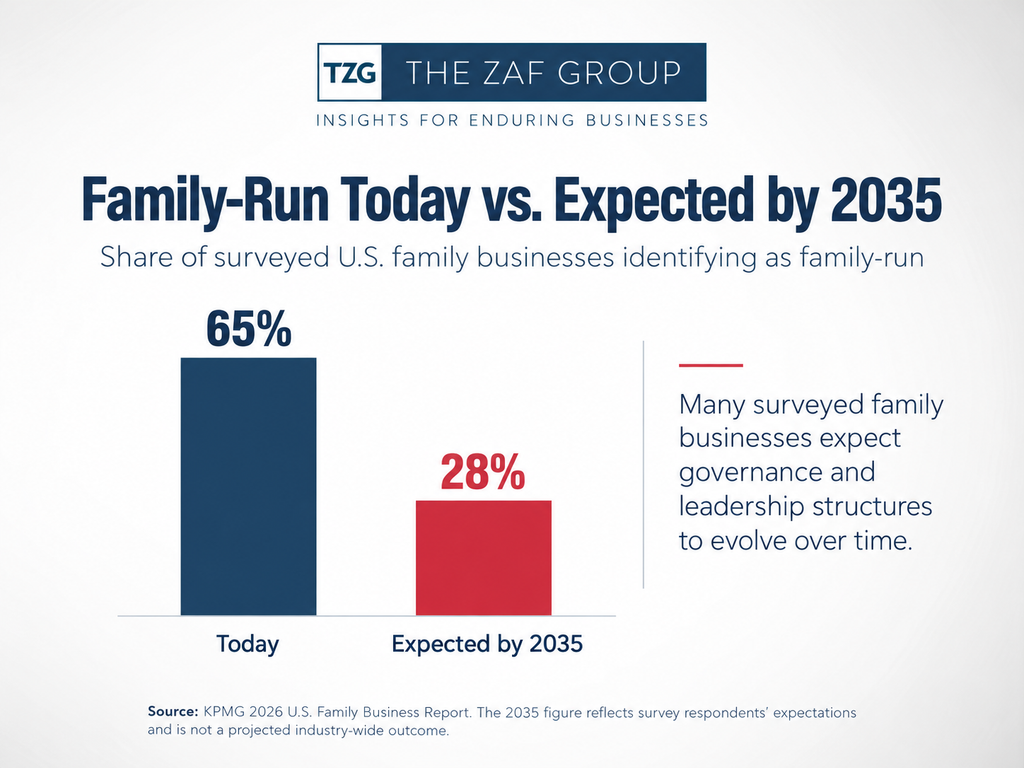
This signals an important evolution in how family businesses think about succession planning. Ownership and management do not necessarily need to remain in the same hands. A family may choose to retain ownership while bringing in experienced executives. It may prepare the next generation for board and governance responsibilities. It may explore a partnership with an investor or long-term owner that shares its values.
In other cases, a transition to new ownership may provide the best opportunity for the company to continue growing. There is no single solution that fits every family or every business. What matters is approaching the transition deliberately, with a clear understanding of the company’s identity, the family’s objectives, and the capabilities needed for the future.
For founders, this means looking beyond the transaction itself.
- Who will lead the company?
- How will its employees and customers be treated?
- Will its values continue to shape important decisions?
- And will the business have the resources, leadership, and strategic direction needed to fulfill its potential?
These are questions of stewardship as much as succession.
Building for the Future Requires Investing in People and Capabilities
Preserving a company’s heritage is essential. But so is ensuring that the business remains competitive. A strong reputation alone cannot guarantee future success. KPMG’s report highlights several challenges facing family enterprises as they prepare for growth. Attracting high-quality external talent is the most frequently cited workforce challenge, identified by 39% of respondents.
Meanwhile, 86% report piloting AI or implementing it at scale, yet only 40% have established formal AI governance frameworks. The technology findings illustrate a broader issue: growth ambitions can move faster than the organizational capabilities required to support them.
As businesses scale, they often need stronger management systems, clearer accountability, improved technology infrastructure, and new leadership capabilities. They may need to professionalize certain functions, develop internal talent, strengthen sales effectiveness, or establish a more disciplined operating cadence.
None of these improvements should come at the expense of the culture and values that helped the company succeed. In fact, the opposite should be true.
The best operating systems reinforce what makes a business strong. They give employees clearer priorities, help leaders make better decisions, improve customer experiences, and create a foundation for sustainable growth. This is why continuous investment in people and leadership development matters so much. A company’s future depends not only on the strategy it chooses, but also on the people responsible for bringing that strategy to life.
Respecting Heritage While Building Enduring Businesses: The TZG Approach
Our approach to business building has long been grounded in a simple principle:
Respecting heritage, helping build winning businesses, one at a time.
As a family office founded by Mike and Robin Zafirovski, we understand the importance of long-term thinking, personal relationships, and values-driven leadership. Since 2016, a core part of our strategy has been to acquire and build well-run family-owned businesses, particularly where succession creates an opportunity for a new ownership partner.
Our objective is not simply to acquire businesses and pursue short-term financial outcomes. We seek to build enduring companies by respecting their history, working closely with leadership teams, investing in people, and strengthening the capabilities required for continued success.
Importantly, we do not believe that a change in ownership should mean a loss of identity. A founder’s legacy can remain an important part of the company while new ideas, talent, systems, and growth opportunities help move the business forward.
That philosophy is reflected in The Zaf Group Way, our operating approach built around leadership development, strategic alignment, operational excellence, growth initiatives, and disciplined execution. Our operating cadence brings management and boards together regularly to focus on the fundamentals: people and culture, strategy, growth, and financial planning. We also emphasize continuous improvement, customer relationships, accountability, and the development of future leaders.
Underpinning this approach are our ICARE2 values: Integrity, Collaboration, Accountability, Responsibility, Excellence, and Effectiveness.
These are more than statements of intent. They provide a common set of principles for how we lead, how we work with our portfolio companies, and how we build relationships with employees, customers, and partners. We believe that financial performance and values-driven leadership should reinforce each other.
Strong businesses need both.
Building Something Worth Passing On
KPMG’s research highlights a meaningful transition in the U.S. family business landscape. Family owners remain confident in their ability to grow, but many recognize that the structures and capabilities needed for the future will look different from those that brought them success.
That evolution should be viewed as an opportunity. With thoughtful succession planning, the right leadership, strong governance, and a commitment to continuous improvement, family-owned businesses can preserve their most important strengths while preparing for new opportunities.
For The Zaf Group, the objective remains consistent. Respect the people and history that made a company successful. Build on its strengths. Invest in its leadership, capabilities, and culture. And maintain the discipline and long-term perspective needed to create enduring value.
Because the real measure of a successful ownership transition is not simply what changes hands.
It is what the business becomes in the years that follow.
We welcome conversations with founders, family business owners, and leaders thinking about the future of their companies.
